macOS & Windows · Salesforce

A real Salesforce client for your desktop.

Connect to every org you work with. Write SOQL with autocompletion and history, including SELECT *, which Salesforce doesn't have. Run multi-query scripts into separate result tabs, page through hundred-thousand-row results, edit records inline, compare orgs, inspect API limits, run Bulk API jobs with a before/after preview, and copy data from one org to another. All in a fast native app that remembers what you were doing.

Download See pricing

Free for 30 days. No account, no card, no signup.

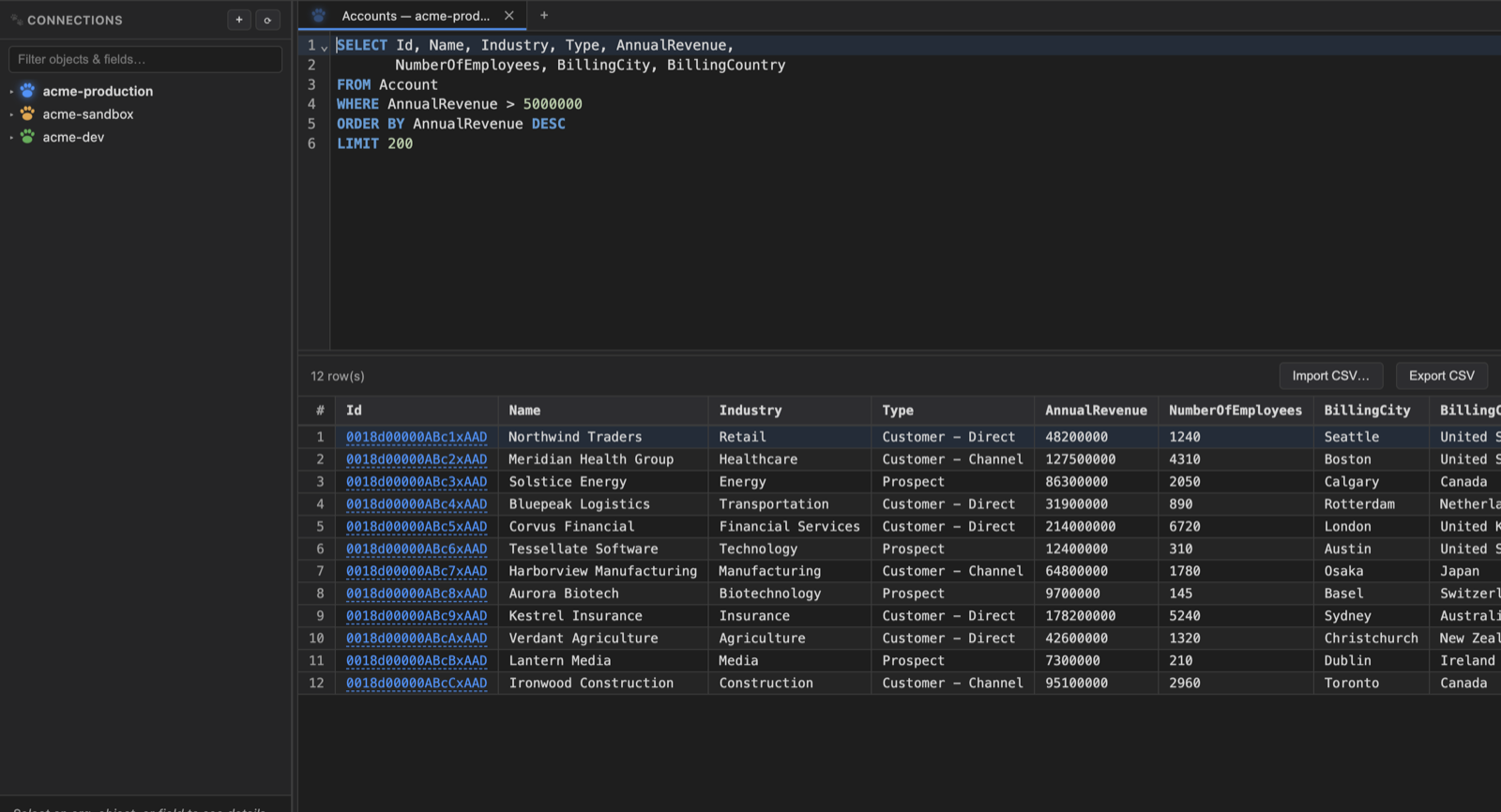
DataPaw showing three connected Salesforce orgs in a sidebar, a SOQL query in the editor, and query results in a sortable grid.
Three orgs connected · SOQL editor with history and result tabs · grid with inline editing

The obvious question

Salesforce Inspector is free. Why pay for this?

A fair question, and worth answering plainly rather than burying. The free tools are genuinely good, and if they cover what you do, use them. Here's where DataPaw is actually different.

SELECT *, which SOQL doesn't have
Salesforce leaves it out on purpose, and its own partial answer caps out at 200 rows. DataPaw expands it against the object's real fields, so you can look at a table without first going to find out what's in it. One shortcut rewrites it in the editor as the full field list, so what you paste into Workbench or an Apex class is ordinary, portable SOQL.
Every org at once
Switch between production, sandboxes and scratch orgs in one window, without logging in and out or juggling browser profiles.
Results that don't fall over
Query results page in as you scroll, so a 100,000-row object opens in a second instead of hanging a browser tab. Sort, edit inline, export to CSV, and keep per-script result tabs while you switch contexts.
Schema you can actually see
Generate an entity-relationship diagram of any set of objects (lookups, master-detail, the lot) and pan around it.
Answers "why does this work in QA but not prod?"
Diff two orgs side by side: objects and fields, validation rules, Apex classes and triggers, and flows compared by what they actually do rather than line by line. Then export the difference as a deployable package.
Move data without spreadsheet surgery
Copy records from one Salesforce org into another, for example seeding a sandbox from production, while DataPaw remaps lookups to the target org’s new record Ids. It can include dependent objects, match existing records by external Id, and show compatibility issues before the copy runs.
See what a bulk load would change, before it runs
Insert, update, upsert and delete through the Bulk API. Before anything is written, DataPaw reads back the records you’re about to touch and shows you the actual before and after, field by field. It tells you how many rows change nothing, and which ones point at records this org doesn’t have. Plus a warning when the data came from a different org, and failed rows exported as CSV.
It's a real app
Your scripts survive restarts. It doesn't break when Salesforce ships a release. It isn't a tab you accidentally close.

What's in it

Built for the work, not the demo.

SOQL editor with autocompletion

Object and field names from your actual org, including relationship traversal and child subqueries. Syntax highlighting, formatting, searchable history, saved snippets, quick object search, and query plans.

SELECT *

Write SELECT * FROM Account and DataPaw sends the real field list. Cmd/Ctrl+Alt+E rewrites it in the editor instead, so what you copy elsewhere is portable SOQL. It leaves out the fields SOQL won't accept, since one of those fails the whole query rather than just itself, and says plainly when an object is too wide to ask for in one go.

Lazy-loaded results

Pages through results using the API's own cursor. Multi-query scripts open closable result tabs, labelled by object, without waiting for a full download.

Inline editing

Double-click a cell to edit it. Typed editors for picklists, dates, checkboxes and numbers, written straight back through the REST API.

Record inspector

Click any Id to see every field on that record, then follow lookups from record to record with a back trail.

Compare two orgs

Objects and fields, validation rules, Apex and flows, diffed across any two connections. Flows compare structurally, so moving a node on the canvas isn't reported as a change. Export what differs as an MDAPI package with the deploy command ready to run.

Copy data between orgs

Seed a sandbox from another org without hand-editing CSVs. Choose objects and record limits, pull in required dependencies, remap lookups to newly-created target records, match users where possible, and optionally upsert on a DataPaw source-id field so the copy is re-runnable.

ER diagrams

Pick a set of objects and get a laid-out relationship diagram, with master-detail and lookups distinguished. Drag nodes, zoom, explore.

Bulk data operations

Insert, update, upsert and delete via Bulk API 2.0, from a CSV or straight from your current results. Before committing, DataPaw samples the target records and shows a typed before/after preview so numbers, booleans, Ids and multipicklists compare correctly. Live progress and failed rows are exportable.

Colour-coded connections

Every org gets a colour by risk and a PROD / SANDBOX / SCRATCH badge, on its row and on every script tab bound to it. Turn on a confirmation prompt for the ones you'd rather not run against by accident.

Live API limits

Daily REST and Bulk usage in a dock that stays open, refreshes itself, and highlights when you're close to the ceiling.

Session persistence

Open tabs, their queries, org bindings and current results all survive a restart. Save named sets of tabs as workspaces and switch between them.

Missing-field checks

Before copying data, DataPaw compares the source rows against the target schema, drops fields the target cannot accept, and can create supported missing custom fields with field-level security so one stale column does not fail an entire object.

It won't hammer a dead session

An expired Salesforce session never fixes itself, so every retry is another failed sign-in, and enough of those can lock a Salesforce account. DataPaw stops using a connection once it knows the session is dead, marks it in the sidebar, and waits for you to sign in again. Other connections carry on unaffected.

Tells you about new versions

Checks for a new release when it starts and shows what changed, with a download link. Quiet otherwise: no "you're up to date" every morning, and nothing at all when you're offline. You can skip a release without silencing the next one.

Nothing to set up

Reuses the orgs you've already authenticated with the Salesforce CLI, or logs into new ones from inside the app. No CLI yet? DataPaw installs its own copy. No admin password, no Homebrew, no terminal.

Twenty-four themes

Dracula, Nord, Solarized, Gruvbox, Tokyo Night and the rest of the familiar ones, plus a quieter set built for long sessions: near-neutral backgrounds, low colour, and a High Contrast option for bright rooms. Picked from the native app menu.
Pricing

One price. Everything included.

No tiers. No per-seat minimums. No "contact sales". One price, the whole app, every update.

Founding price · rises to $99
$49 per year
  • Every feature. No tiers, no add-ons, nothing held back.
  • Two computers: your desktop and your laptop.
  • Every update, for as long as you're subscribed.
  • Locked at $49 for as long as you stay subscribed. The price rises for everyone who comes later. Never for you.

Try it first. The download is the complete app, not a demo, and the 30-day trial needs no card. Buy whenever you're convinced. Cancel any time from the customer portal; a lapsed subscription stops connecting to Salesforce orgs, but your saved scripts and local CSV files keep working.

Download

Try it for 30 days.

Full functionality, no account, no card. The trial starts when you first open it. If DataPaw can't find the Salesforce CLI on your machine, it offers to install it for you, with no admin password needed.

macOS

macOS 11 or later. Signed and notarized by Apple, so it opens without warnings.

Windows

Windows 10 or later, 64-bit. Signed with a verified publisher certificate, so the installer names a real publisher rather than "Unknown". Windows may still show a SmartScreen prompt on a brand-new release. Choose More info → Run anyway. The portable build runs without installing anything.

Version 1.0.5 · All releases

Questions

The things people ask.

Does my Salesforce data go through your servers?

No. DataPaw runs entirely on your computer and talks directly to Salesforce using your own credentials. Your queries and records never touch our infrastructure. We have no way to see them.

Can it copy data from one org to another?

Yes. Copy Data From Another Org is built for seeding sandboxes and moving representative data between orgs. It inserts records in dependency order, remaps lookups to the new target-org Ids, handles cycles with a second linking pass, can match existing records by external Id, and reports target-schema or validation-rule problems before they turn into a wall of row failures.

What happens when the trial ends?

Connecting to Salesforce orgs stops working until you buy a licence. Your saved SOQL scripts stay readable and exportable, and local CSV import and export keep working. Nothing gets deleted, and a licence key restores everything instantly.

How does it authenticate to Salesforce?

Through the official Salesforce CLI, using standard OAuth. You log in through your browser exactly as you would normally. DataPaw never sees or stores your password. Orgs you've already authenticated with the CLI show up automatically.

Can I use it on my laptop and my desktop?

Yes. A licence covers 2 computers. If you replace a machine, you can release the old one from inside the app and activate the new one yourself.

How do I get new versions?

DataPaw checks for a new release when it starts and shows you what changed, with a download link. It stays quiet when there's nothing to report, and you can skip a release without silencing the next one. Updates are announced rather than installed for you, so applying one means downloading the installer, which is the same file as a fresh install and keeps your scripts, settings and connections.

Does it work offline?

Salesforce itself obviously needs a connection. But licence checks are generous: DataPaw keeps working for 30 days without reaching our licence server, so a flaky VPN or a locked-down network won't lock you out mid-flight.

Do you collect usage data?

Only if you say yes. Analytics are off unless you explicitly turn them on, and even then they're anonymous: no queries, no record data, no org names, no field names. There's a button in the app that prints exactly what would be sent, so you can check rather than trust us.

How do I cancel, or change my payment details?

From the customer portal, where you can cancel, update your card, download invoices, and retrieve your licence key. Sign in with the email you bought with; it sends you a one-time code, so there's no extra password to keep. You can also reach it from inside the app, under Manage subscription. And support@xenshift.com reaches a person.

What if I don't like it?

Email us within 30 days and we'll refund you in full, no questions. The 30-day trial means you shouldn't need to, but the option is there.

Does it run on Windows?

Yes. There's a signed installer and a portable build that runs without installing anything, which is useful on a locked-down machine. Both are signed with a verified publisher certificate, so Windows names a real publisher instead of "Unknown". You may still see a SmartScreen prompt on a brand-new release: Microsoft builds that trust per file over time as a release is downloaded, and no certificate skips it. Choose More info → Run anyway.